You sit down to read your child's latest composition. The opening pulls you in. The build-up is tense. The climax actually works, and you find yourself wanting to know what happens next.
Then the last paragraph arrives, and the whole thing deflates.
"In the end, everything was fine. I learnt that I should always be honest. Then I went home and had dinner."
Sound familiar? If your child writes a strong story and then ends it with a rushed, flat, or recycled final paragraph, you are not alone. Every English teacher in Singapore will tell you the same thing: the ending is where good compositions quietly lose marks. A child can do almost everything right and still cap their score because the story does not land.
The good news is that endings are not a talent. They are a skill, and a surprisingly teachable one. Better still, the fix does not happen at the end of the writing process. It happens before your child writes a single word.
Why endings collapse (it is not really about time)
The usual explanation is that children run out of time. That is true, but it is the symptom, not the cause. The real problem is that most children discover their ending while they are writing, instead of deciding it before they begin.
Here is what that looks like in practice. A child reads the topic, gets an exciting idea for an opening, and starts writing immediately. The story builds nicely. The climax is dramatic. And then, somewhere around the fifty-minute mark, they look up and realise two things at once: they do not actually know how the story should end, and they have only a few minutes left to figure it out.
So they scramble. They tie everything up in one hurried sentence, reach for a moral they have memorised, and put their pen down. The ending feels bolted on because, in a sense, it was.
The pattern is predictable: a generous opening, a well-developed middle, and an ending squeezed into whatever time and space is left over. The reader feels the drop in energy, and so does the marker.
What a strong ending actually does
Before we fix the problem, it helps to be clear about what markers are looking for. A strong ending is not a dramatic twist or a clever proverb. It does three quiet things well:
It resolves the conflict clearly. The reader knows exactly how the problem was settled. Not "everything was fine," but specifically what happened.
It reflects, briefly. One or two sentences showing how the character felt or what changed in them. This is where maturity shows, and it is best shown through thought or action rather than a stated lesson.
It connects back. The best endings echo something from the opening or the theme, giving the reader a satisfying sense that the story has come full circle.
Notice what is missing from that list: new characters, new plot points, and grand life lessons. A composition is short. The ending is not the place to introduce anything new. It is the place to close what is already open.
The same story, two endings
Let us make this concrete. Imagine a child has written a story about lying to a friend and then feeling guilty about it. Here is how many children end it under pressure:
The conflict is resolved in the weak ending, technically, but it is rushed. The lesson is a borrowed phrase. The football detail is filler. The reader feels the story stop rather than finish.
Same plot. Same length, more or less. But the stronger ending resolves the conflict with a specific moment, reflects through a feeling rather than a slogan, and closes on a thought that connects back to the guilt the story was built around. It feels earned because the writer knew where they were heading.
The fix: plan the ending first, in three questions
This is the part most preparation skips. Everyone tells children to plan, but planning usually means sketching the opening and the build-up, then hoping the ending takes care of itself. It rarely does.
Instead, before your child writes anything, have them answer three short questions, in this order:
1. What is the problem? In one sentence. "My character lies to a friend and feels guilty."
2. How is it resolved? Decide the actual ending now, not later. "He confesses, and his friend forgives him quietly."
3. What changes in the character? The reflection, in one phrase. "He realises the lie weighed more than the truth."
That is the whole exercise. Thirty seconds, three answers. But it changes everything, because now your child is writing towards a destination instead of away from a starting point. The build-up has a purpose. The climax has somewhere to go. And when they reach the final paragraph, the ending is already decided. They simply have to write it well.
A child who knows their ending before they start almost never runs out of time, because they stop padding the middle and stop wandering off the theme. The clock stops being the enemy.
The four endings to retire
Once your child is planning endings deliberately, it helps to know which ones are far too common. Gently steer them away from these:
The disappearing act. "Then I woke up and it was all a dream." This undoes the entire story and tells the reader none of it mattered.
The borrowed moral. "I learnt that honesty is the best policy." If the lesson is a proverb your child did not write themselves, the marker has read it a hundred times already.
The full stop. "Then I went home and had dinner." The story runs out before it finishes.
The new arrival. A fresh character or twist in the final lines. There is no room left to develop it, so it only confuses.
None of these are about ability. They are about a child reaching the end with no plan and grabbing the first thing within reach.
A five-minute practice you can do at home tonight
You do not need to be an English teacher to help with this. You just need a past composition topic and five minutes.
1. Pick any topic. Use a past PSLE theme or one from your child's school. Do not write the full story.
2. Plan the ending only. Ask the three questions: what is the problem, how is it resolved, what changes in the character. Have your child answer out loud.
3. Write just the final paragraph. Two to four sentences. Resolve, reflect, connect. That is all.
4. Read it back together. Ask one question: does this feel finished, or does it feel stopped? Your child will usually know the difference instantly.
Doing this even twice a week trains the instinct that matters most: deciding the destination before the journey. After a few sessions, planning the ending first stops being a chore and starts being the natural first move.
Where Word Wizards helps
Practising endings at home is powerful, but children improve fastest when they can practise the ending on its own, over and over, without having to write a whole story each time. That is the part that is hard to do alone, and it is exactly what Word Wizards is built for.
Inside Word Wizards there is a feature called Pick Your Part, which lets your child practise just one section of a composition at a time. So instead of writing a full story to work on a single weakness, they can focus purely on endings, writing conclusion after conclusion to different stories until resolving, reflecting, and connecting back become second nature.
Each attempt comes with feedback aligned to the way PSLE composition is marked on Content and Language, so your child can see whether their ending actually lands or simply trails off, and every practice finishes with a model answer they can learn from.
This is the quiet advantage of practising a part rather than the whole. A child who writes ten full compositions might only write ten endings, often rushed and tired by the time they reach them. A child using Pick Your Part can write ten endings in a single sitting, fresh each time, and that focused repetition is how a real skill is built.
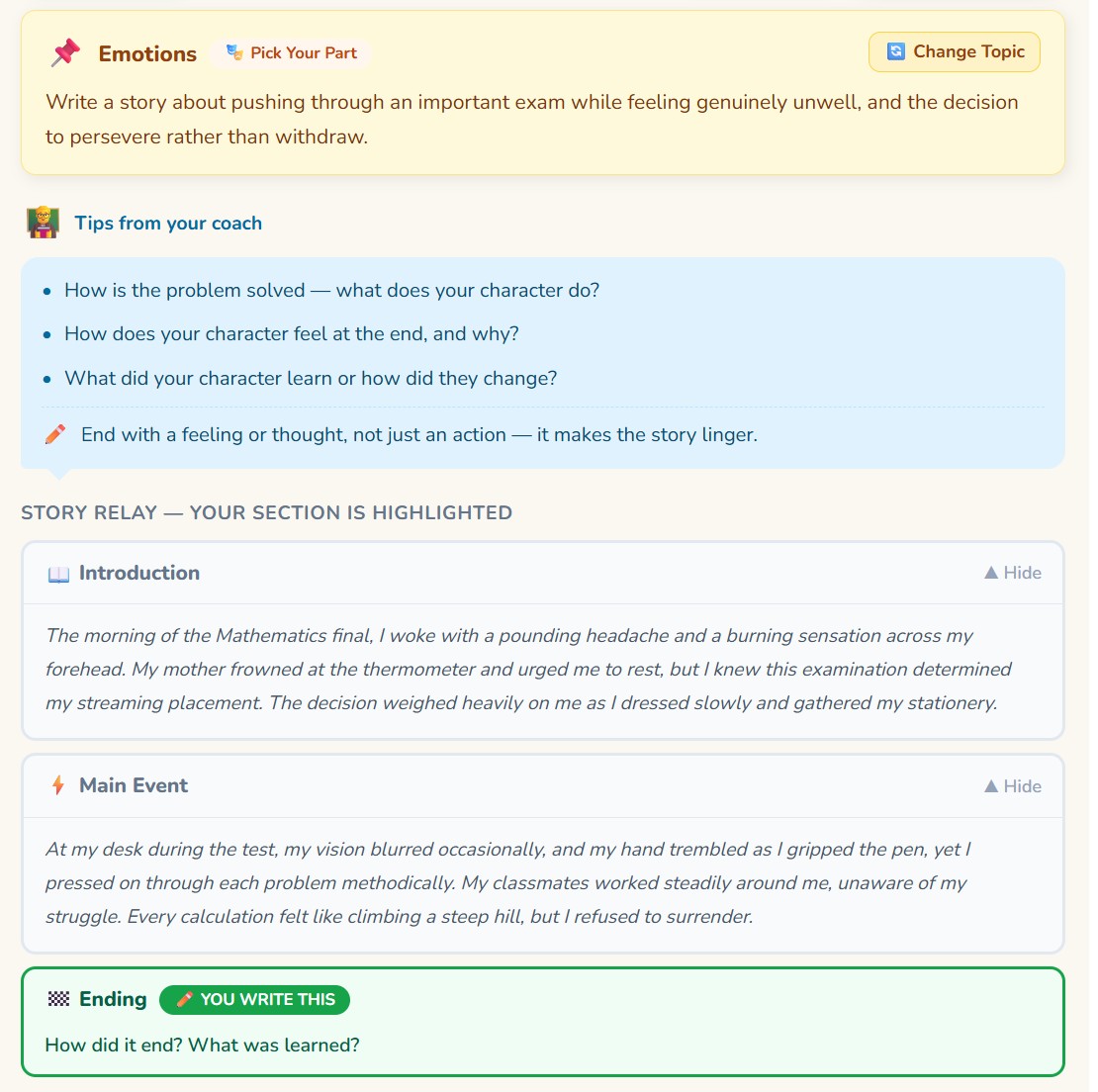
The Pick Your Part feature on Word Wizards — practise just the ending, with coach tips and a model answer after every attempt.
The bottom line
A weak ending is rarely a sign that your child cannot write. More often, it is a sign that they started writing before they knew where they were going.
Decide the ending first. Ask three questions. Write towards the destination. It is a small shift in habit, but it is the difference between a story that stops and a story that lands — and at the top of the achievement bands, that difference is worth real marks.
Try 'Pick Your Part' on Word Wizards
Word Wizards is an AI-powered English writing and composition coaching platform for Singapore primary school students (P1 to P6). Children practise one section at a time, get instant feedback, and see a model answer after every attempt.
Try it free at wordwizards.sg →Free trial · No card required · Cancel anytime


Related reading
- →Show, Don't Tell: What It Actually Means and How to Teach It to Your Child
- →Your Child Practises Maths 5 Times a Week but Writes Compositions 4 Times a Year. That Gap Explains More Than You Think.
- →Past PSLE Composition Topics: Why They Matter Less Than You Think
- →6 PSLE Composition Mistakes That Cost Real Marks