Past PSLE Composition Topics: Why They Matter Less Than You Think (And What Actually Helps Your Child Succeed)
The instinct to study past topics makes sense. But there's a ceiling. Here's what it is, why it matters, and what your child actually needs to keep improving.

It's one of the most searched PSLE phrases in Singapore. As the exam draws closer, anxiety builds, and parents across the island start typing the same thing into Google:
"Past PSLE composition topics"
The instinct makes sense. If we know what came before, we can prepare for what's coming next. Pair the list with the model compositions your child has filed, get them to memorise a strong piece for each recurring theme, and tweak it on exam day.
It's a sensible strategy. It works, but only up to a point. Understanding exactly where that point lies is the difference between a child who plateaus at a decent score and one who breaks through to the top.
Before we explain why, let us show you what actually closes that gap.
The bridge between memorisation and mastery
At Word Wizards, we built our platform around a simple cycle that mirrors how the best preparation works: tips that frame thinking, independent writing, personalised feedback on Content and Language, and a model answer that closes the loop. Here is what that looks like in practice, using a sample composition on the topic "being caught in a storm during a boat trip."
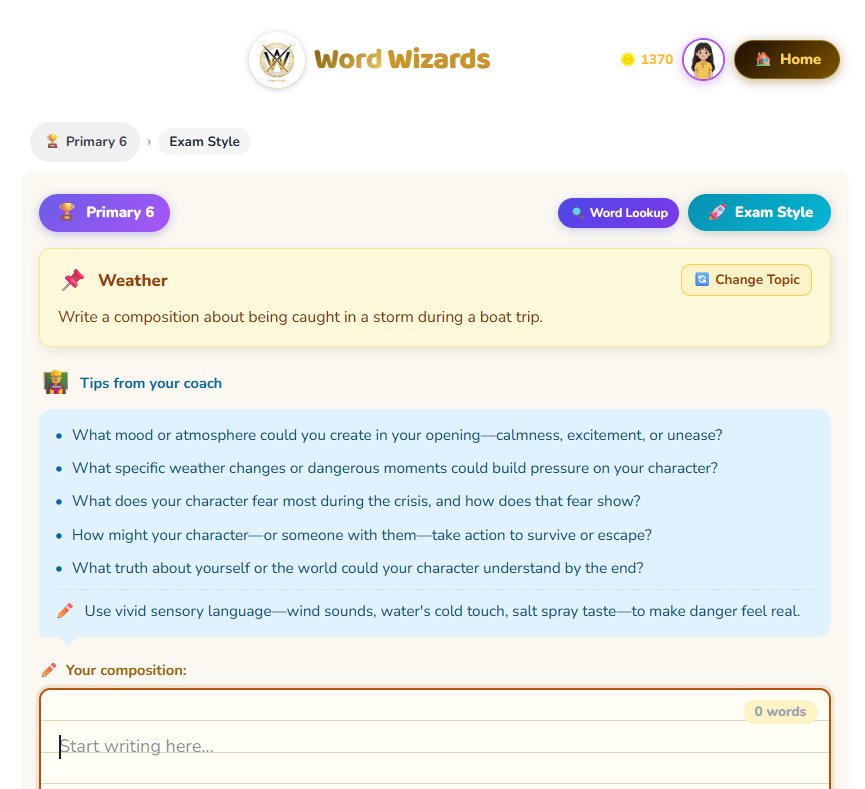
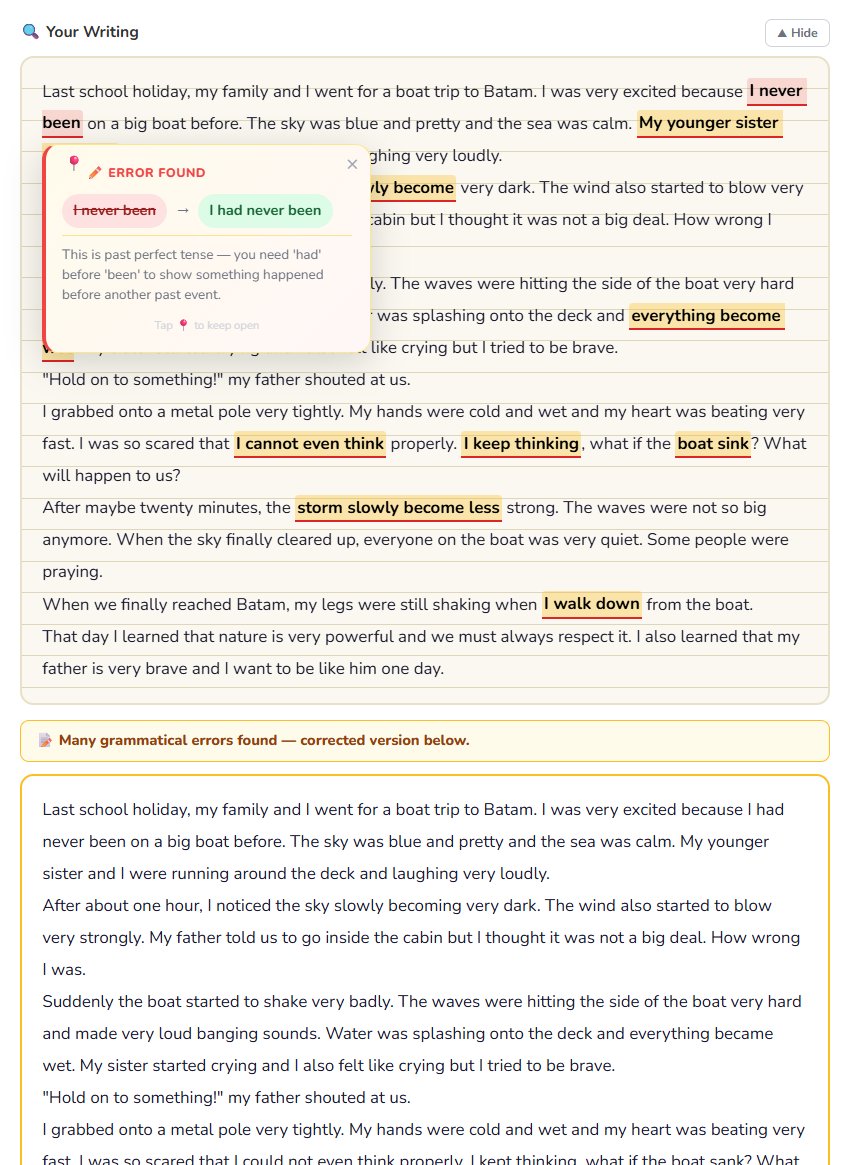
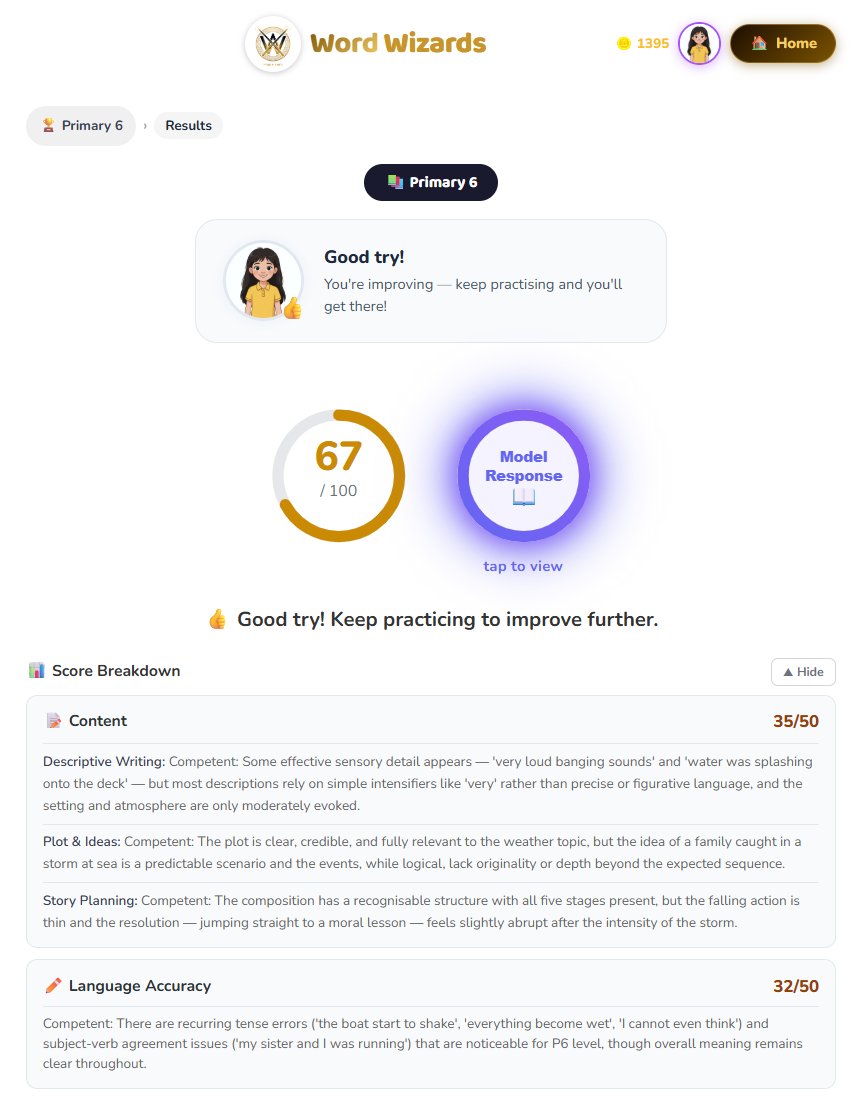
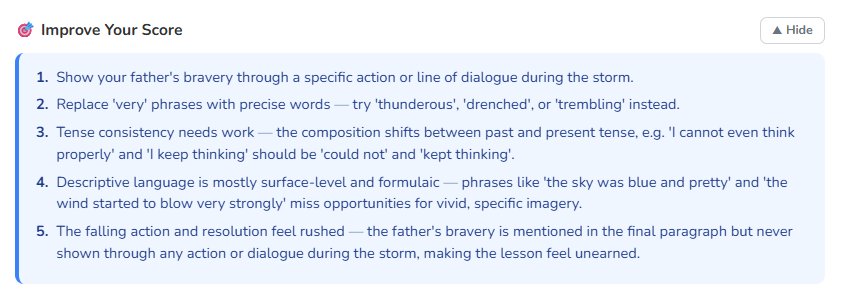
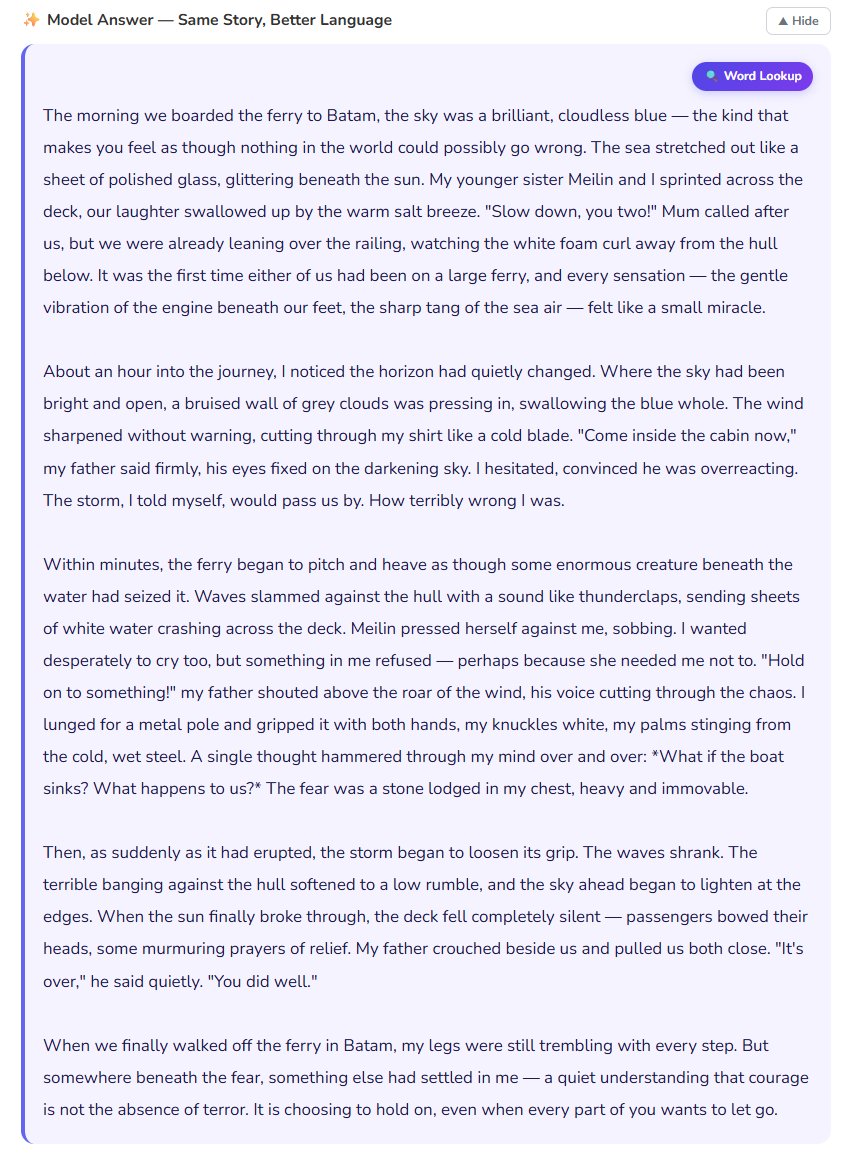
The more your child works through this cycle on varied topics, the more flexibly they write under pressure on exam day. Now let's explain why this matters so much.
What past topics and model compositions actually do for your child
Let's give credit where it's due. Studying past PSLE composition topics and memorising well-written phrases under each recurring theme is a foundation strategy that works. Here's why.
The emotional territory of PSLE composition is narrow. Looking at the last decade:
| Year | PSLE Composition Topic |
|---|---|
| 2015 | Being Considerate |
| 2016 | A Secret |
| 2017 | A Special Gift |
| 2018 | Teamwork |
| 2019 | A Celebration |
| 2020 | Something That Was Lost |
| 2021 | A Promise |
| 2022 | A Long Wait |
| 2023 | A Change for the Better |
| 2024 | Trying Something New |
| 2025 | Being Thankful |
Almost every one falls into one of five themes: personal growth, moral choice, loss and recovery, relationships, and overcoming difficulty. A child who arrives at PSLE having internalised strong model compositions for each theme walks in with:
- A reliable bank of plot structures to adapt to the day's topic
- Memorised phrases and idioms that strengthen "show, don't tell" descriptions
- Pre-rehearsed vocabulary that lifts Language marks
- Confidence, which under exam pressure is worth more than most parents realise
This is not a small thing. A child who has done this foundation work properly will outperform one who walks in cold, every time. If your child is currently building that base, keep going. It matters enormously. But this strategy alone isn't enough.
The ceiling of memorisation
Here's what happens in the exam hall. The child opens the paper. The topic is almost like one they've prepared, but not quite. The pictures are unfamiliar. The model composition they memorised doesn't quite fit.
Now one of two things happens.
The children who score well are almost always on Path B. They have developed the ability to craft an original story in response to what's on the page in front of them, under time pressure.
You can stock the toolkit with a hundred memorised phrases, but if the child can't deploy them flexibly in response to a slightly unfamiliar topic, the toolkit doesn't help.
The 2025 PSLE topic illustrates this perfectly. Being Thankful is warm and familiar, well within the emotional territory every P6 child has prepared for. But the pictures? A class party, a sunflower, and a "give way to elderly" sign. Children who had memorised a generic gratitude composition had to adapt their story to fit one of those specific scenes on the spot. The ones who could do that scored well. The ones who tried to force a pre-prepared story onto an unfamiliar image, didn't.
What the marking scheme rewards
To understand why this matters at the top end, look at what examiners actually mark. PSLE Continuous Writing is split evenly between:
| Category | What it covers | |
|---|---|---|
| Content | Development of ideas, relevance to the visuals, creativity, coherence | 50% |
| Language | Grammar, punctuation, sentence structure, spelling, vocabulary | 50% |
Your child needs to do well in both categories. Memorisation helps with parts of both: memorised phrases boost Language, memorised plot structures boost Content. So far, so good.
But the top bands of each category reward things that memorisation cannot fully provide.
This is why the gap between a good score and a great one isn't closed by more memorisation. It's closed by the ability to write well in the moment, drawing on what's been learned but responding to what's actually been asked.
What your child actually needs to move up
If your child has done the foundational work and you're wondering why they've plateaued, here's what tends to be missing.
Volume of original writing on varied topics
Writing is a craft, and like any craft, it only sharpens through practice. A child who has personally written fifty compositions across varied topics, even imperfect ones, will outperform a child who has memorised twenty perfect ones. The more varied the topics, the stronger the adaptation skill becomes.
Feedback on what they actually wrote
This is the part that's hardest to access. A model composition is already polished. Every phrase has already been deemed good. But when your child writes their own composition, they need someone to tell them what worked, what fell flat, and where the grammar slipped. Without that feedback, they don't know what to fix. They just keep repeating the same mistakes.
Word Wizards gives your child that feedback. Not just a score, but every error highlighted in the text itself, with a clear explanation of why it's wrong and what to use instead. And the feedback doesn't stop at what went wrong. It tells your child exactly what to do next time, with a prioritised list of improvements they can act on immediately.
A model answer that closes the loop
Word Wizards rewrites your child's own story with stronger language, deeper imagery, and better craft. So they don't just see what a perfect composition looks like in the abstract. They see what their composition could have looked like. That distinction matters: the lesson sticks because the story is already theirs.
Where Word Wizards fits
Word Wizards is built to work like a coach. Your child gets composition tips to frame their thinking, writes independently, and receives personalised feedback on Content and Language. A model answer closes the loop.
The more your child works through this cycle on varied, unfamiliar topics, the more the techniques they've studied become skills they can use flexibly, under pressure, on any topic that comes up on exam day.
See what real-time writing coaching looks like
Try Word Wizards free. Your child writes a composition and gets instant, examiner-aligned feedback.
Try Word Wizards Free →First month on us · No card required · Cancel anytime