
If you've searched this topic before, you've probably read the same advice five times: plan your story, use better vocabulary, show don't tell. We're not going to do that.
This article shows you, mistake by mistake, exactly what an examiner's red pen does to a child's composition and English writing: what gets circled, what gets a tick, and where marks actually come off. Most online advice is written for the child. This one is written for the parent who has to figure out what's wrong by reading the notebook.
By the end, you'll be able to run a 2-minute diagnostic on your child's last composition and know whether there is a Content problem or a Language problem. (Yes, there's a difference, and most parents fix the wrong one.)
Let's go.
First: How the marking actually works (the part most parents skip)
You can't diagnose mistakes if you don't know what's being assessed. The PSLE Continuous Writing composition is marked out of 36, split into two halves:
PSLE Composition Marking Breakdown
Here's the part nobody tells you: these two scores are largely independent. A child can have beautiful vocabulary and still score 7/18 on Content because the story makes no sense. Another child can have a gripping story and lose 8/18 on Language because of consistent tense slips.
When a parent says, "my child got 22/36, how do we improve?", the first question is always: what was the Content/Language split? Ask your child's teacher. The fix for 14C/8L is completely different from the fix for 8C/14L.
Most online advice treats composition as one undifferentiated skill. That's the first reason generic advice doesn't move scores. Now, let's look at the six mistakes that cost real marks.
The "Plot Without a Problem" Story
What it looks like: The child writes a chronological account of a day, an outing, or an event. They go to the beach, eat ice cream, play in the sand, go home. Nothing goes wrong. Nothing is at stake.
This is grammatically fine. Spelling is fine. The marker will still award around 7–9/18 for Content. Why? Because a story without a problem is a diary entry, not a narrative. There's no tension for the reader to resolve, no character growth, no point.
Open your child's last composition. Underline the sentence where something goes wrong. If you can't find one, that's the diagnosis. Not vocabulary, not grammar. Their stories don't have a problem to solve. The fix is teaching them the Story Mountain structure: Set-up → Build up and Problem → Climax → Falling Action → Resolution.
Tense-Slipping Mid-Paragraph
What it looks like: The composition starts in past tense (as PSLE narratives should), then quietly drifts into present tense, often during dialogue or action sequences.
Four verbs in three sentences are in the wrong tense. This single mistake can cost 2–3 Language marks in a single composition. Across the paper, it can be the difference between AL3 and AL2.
Read your child's composition out loud, but only the verbs. Walked. Was. See. Freeze. Feel. Heard. The slips become obvious. Naming the verbs aloud is a more powerful proofreading technique than re-reading the sentence.
Each underlined verb is a Language deduction. Tense slips are among the most common, and most fixable, mistakes in PSLE compositions.
The "Bombastic Word" Trap
This is the most popular online myth: that PSLE compositions are scored on impressive vocabulary. Parents buy thick books of "good phrases." Children memorise "the sky was a canvas of amethyst and gold" and shoehorn it into every story.
In marking, the simpler "My friend was very upset" is closer to the actual marking standard: effective communication, not linguistic showmanship.
Find one "bombastic" phrase in your child's composition. Ask them: what does this word actually mean? If they can't explain it precisely, it's not their word yet. The rule: a child should never use a word in a composition that they couldn't use in conversation with you that evening.
Dialogue Overload (the "Script Composition")
What it looks like: Two thirds of the composition is dialogue. He said, she said, he replied, she shouted. The narrative barely advances.
Six lines of dialogue, zero plot progress. This costs Content marks (under-developed plot) and often Language marks (repetitive sentence structures, weak speech tags).
Count the lines of dialogue in your child's last composition. If it's more than 30%, you've found the mistake. The rule of thumb: every line of dialogue should either advance the plot, reveal character, or both. Small talk doesn't count.
The Vanishing Resolution
What it looks like: Strong opening, decent middle, then the last paragraph collapses. The problem gets resolved suddenly, often with a deus ex machina (a parent appears, the alarm rings, "it was all a dream").
Three sentences of climax, one sentence of resolution, one moral tag. The "moral of the story" sentence is almost always a sign of a rushed ending; children deploy it as a shortcut when they don't know how to land the plane.
Look at the paragraph lengths. If the final paragraph is less than half the length of the climax paragraph, the ending is rushed. Teach them to allocate the last 10 minutes of the writing window to the resolution, no matter where they are in the story.
Off-Topic Writing (Often Disguised as On-Topic)
What it looks like: The composition technically mentions the topic, but the story is about something else entirely.
The marker sees this immediately. The story is about achievement, not helpfulness. The tag-on sentence doesn't redeem the content.
Look at the last three composition topics your child wrote about. For each, can you state the theme in three words? Does each story serve that theme, or just touch it? A child who consistently produces "adjacent to the topic" stories has a topic-decoding problem, not a writing problem.
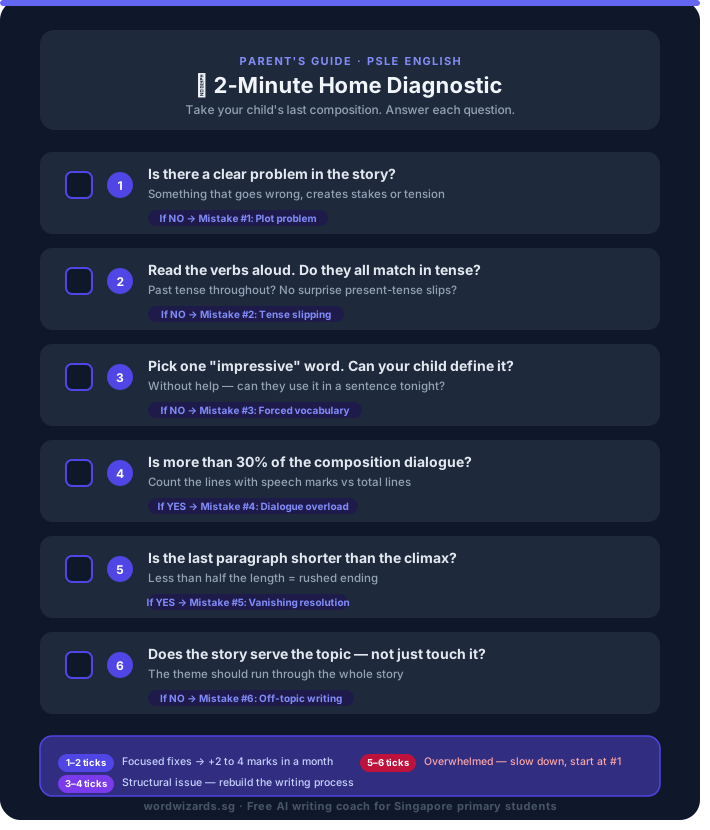
Save or screenshot this card to use as a quick reference when checking your child's next composition.
Why most of this advice fails in practice
Even parents who read articles like this one struggle to apply them, for one reason: the diagnosis happens after the composition is written, but the fix has to happen when the child is writing.
This is the gap Word Wizards was built to close. When a child writes a composition on wordwizards.sg, they get instant feedback from an AI writing coach, not after a tutor reads it next week. The system flags tense slips as they happen, points out where the plot lacks a problem, and shows the child what an examiner would mark in red. The child learns the skill, not just the score.
That's the difference between coaching and grading. PSLE composition improvement is a coaching problem, not a marking problem.
See what real-time writing coaching looks like
Try Word Wizards free for a full month, no credit card, no commitment. Your child writes a composition; they get instant, examiner-aligned feedback while they type.
Try Word Wizards Free →First month on us · No card required · Cancel anytime
Frequently Asked Questions
Yes. PSLE composition scores are inherently noisier than maths or science because they depend on topic fit. The right diagnostic isn't the score on any single composition. It's whether the same types of mistakes keep appearing. Run the diagnostic above on three recent compositions, not just one.
Memorising word lists out of context is mostly wasted time. Memorising 20 emotion-specific words your child can actually use in writing within a week is high-value. Quality over quantity, always.
With focused practice on the right mistake, 2–4 marks within a month is realistic. 6–8 marks within a term is achievable. Anyone promising more than 10 marks in a term is either lucky or lying.
Tutors typically see compositions once or twice a week, with feedback that arrives days after the writing. Word Wizards is for the practice that happens between tuition sessions: the daily reps where the actual habit-building happens. The two stack well; we're not a replacement for a good tutor.